
Technology is evolving at an unprecedented pace. Innovations that once belonged only to science fiction are rapidly becoming part of everyday life. From artificial intelligence capable of making decisions on its own to computers that solve problems beyond the reach of today’s supercomputers, the next few years could redefine how humanity works, communicates, travels, and even receives medical treatment.
As we move closer to 2030, several emerging technologies are expected to become major drivers of economic growth, scientific progress, and digital transformation.
1. Autonomous Artificial Intelligence
Artificial intelligence is no longer limited to answering questions or generating content. The next generation of AI systems will be capable of planning, reasoning, and completing complex tasks with minimal human supervision.
Businesses are already exploring AI agents that can manage workflows, analyze data, assist customers, and automate entire operations. Experts predict that autonomous AI will become a critical part of everyday business processes across industries.
2. Brain-Computer Interfaces
Brain-computer interface technology aims to create direct communication between the human brain and digital devices.
Companies and research institutions are developing systems that could help people control computers, robotic limbs, and other devices using neural signals alone. Beyond medical applications, future versions may transform how humans interact with technology.
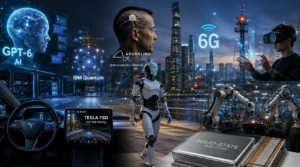
3. Quantum Computing
Quantum computers use quantum bits, or qubits, allowing them to process information in ways that traditional computers cannot.
This technology has the potential to revolutionize:
- Drug discovery
- Climate modeling
- Financial forecasting
- Logistics optimization
- Advanced cybersecurity
Major organizations including IBM, Google, and Microsoft continue to invest heavily in quantum research.
4. 6G Networks
While many regions are still expanding 5G coverage, researchers are already working on 6G networks.
Expected around 2030, 6G could deliver:
- Ultra-fast connectivity
- Near-instant communication
- Intelligent network management
- Massive device connectivity
These capabilities could enable new technologies such as holographic communications, advanced autonomous systems, and smart cities.
5. Humanoid Robots
Robots are becoming more sophisticated thanks to advances in artificial intelligence and machine learning.
Humanoid robots are being designed to perform tasks in:
- Manufacturing
- Healthcare
- Logistics
- Customer service
- Home assistance
By 2030, robots may become common collaborators in workplaces around the world.
6. Solid-State Batteries
One of the biggest challenges facing electric vehicles is battery performance.
Solid-state batteries promise:
- Faster charging
- Longer lifespan
- Increased safety
- Higher energy density
This breakthrough could accelerate the adoption of electric vehicles and renewable energy storage systems.
7. Extended Reality (XR)
Extended Reality combines:
- Virtual Reality (VR)
- Augmented Reality (AR)
- Mixed Reality (MR)
These technologies are expected to transform education, healthcare, training, entertainment, and remote collaboration by creating immersive digital experiences.
8. Precision Gene Editing
Technologies such as CRISPR continue to advance rapidly.
Scientists are exploring ways to edit genes with greater precision to help treat genetic disorders, improve disease prevention, and personalize medical treatments.
This field could become one of the most significant medical breakthroughs of the century.
9. Internet of Things (IoT)
Billions of devices are already connected to the internet, but this number is expected to grow dramatically before 2030.
IoT applications include:
- Smart homes
- Smart cities
- Industrial automation
- Connected healthcare
- Intelligent transportation systems
These networks will generate massive amounts of data, helping organizations make better decisions in real time.
10. Digital Twins
A digital twin is a virtual replica of a physical object, system, or process.
Companies are using digital twins to:
- Predict equipment failures
- Improve manufacturing efficiency
- Optimize infrastructure
- Simulate complex scenarios
This technology is expected to become a cornerstone of Industry 4.0.
The Road to 2030
The technologies shaping the future are not distant possibilities—they are already being developed, tested, and deployed around the world. While challenges related to ethics, security, privacy, and regulation remain, their potential impact is undeniable.
Businesses, governments, and individuals who understand these emerging trends today will be better prepared for the opportunities of tomorrow.
The future is not waiting. It is already being built.
Sources
- World Economic Magazine – Emerging technologies and innovation trends toward 2030.
- IBM Quantum Research and Quantum Computing Initiatives.
- Reuters – Developments in Brain-Computer Interface technologies.
- ScienceDirect – Research on 6G technological directions and future communications.
- Scientific research on CRISPR gene editing and advanced biotechnology.
- Industry reports on Artificial Intelligence, Robotics, IoT, and Digital Transformation.
By Joselyn Pesantez Polanco | SILVIA PRO® 💙